Not Just Because of Granite: How Italian Masters Helped Korostyshiv Become a City of Stonecutters
Source: Zhytomyr Online
Korostyshiv has long been associated with granite. But the deposits of stone alone were not enough for the city to become one of Ukraine’s best-known stone-processing centers. For that, people had to appear who knew how to turn a block into steps, a slab, a sculpture or a complex gravestone, and to pass this skill on to others.
A new study by historian Olena Mozhovenko and local historian Oleksandra Oliinyk-Polishchuk on the origins of Korostyshiv’s stone-processing industry shows that not only the region’s natural wealth was decisive. An important role was played by Italian masters who in the late 19th and early 20th centuries set up workshops here and trained local men to work professionally with stone.
There Was Plenty of Stone, but Masters Were Needed
Granite deposits in the Korostyshiv area began to be actively developed back in the 19th century. The Encyclopedia of Modern Ukraine dates the start of local granite development to the mid-19th century.
However, the presence of raw material does not create a craft. The researchers Mozhovenko and Oliinyk-Polishchuk drew attention to another factor: the laying of a section of the Brest-Litovsk highway through Korostyshiv brought here masters who saw both rich deposits of stone and an opportunity to start their own business with practically no local competition.
Among the surnames linked to the formation of the industry, the Italian families Rizzolatti and Busetti are especially highlighted.
The Rizzolattis Made More Than Just Blocks of Stone
The production organized by the Rizzolatti family no longer operated as primitive stone quarrying. It made finished products: steps, balustrades, windowsills, washbasins, slabs.
Stone funerary sculpture became a separate line. And they worked not only with local granite but also used imported marble.
This is how Korostyshiv gradually moved from being a place where stone exists to a place where people know how to process it professionally.
Most Important, Locals Began to Be Taught the Craft
The researchers name as the most important result of the Italian masters’ work not even individual products or enterprises.
The Rizzolattis, Busettis and other masters involved local residents in the work and taught them stone-processing technology. According to the study’s authors, two generations of men grew up in stone processing this way.
The skill ceased to belong to a few visiting masters. It remained in the city itself, among workers, families and new workshops. Later the private craft grew into artel production, and later the industry passed to large state production.
Even in the 20th Century, Much Work Was Done by Hand
In 1927 an enterprise for developing and extracting granite was founded in Korostyshiv. It employed 405 people, and practically all operations were done by hand.
That is, the stonecutter’s profession remained for a long time not only an industry but also a heavy manual craft. The stone had to be separated, sawn, shaped, ground and polished.
Technology gradually changed this work. In 1963 the enterprise introduced thermal stone processing, and in the 1970s and 1980s stone-sawing, grinding-polishing and milling-edging machines were installed. According to the Encyclopedia of Modern Ukraine, annual output then grew from 16,000 to 48,000 square meters of product.
From Block to Finished Product Is a Profession of Its Own
Even with modern equipment, working with granite consists of many stages. As far back as 2013, Zhytomyr Online showed the work of one of Korostyshiv’s stone-processing shops: a large block was first split, then cut into blanks of the required thickness, polished, edged and thermally treated.
A local master then explained that the whole path from a large block to a shining finished slab could take several days. And even a small deviation in size mattered for such work.
Stone Became Part of Korostyshiv’s Very Image
Today the city council calls Korostyshiv one of Ukraine’s well-known centers of granite quarrying and stone processing and notes that numerous private stone-processing businesses operate in the city and its surroundings. Even in the city’s official history, the stonecutter stands next to the papermaker, the weaver and the miner among the professions that shaped Korostyshiv.
And the craft long ago went beyond the production shops. Dozens of stone sculptures have appeared in the city park, and in 2024 Zhytomyr Online reported how the sculpture park in Korostyshiv was entered in the Ukrainian Book of Records.
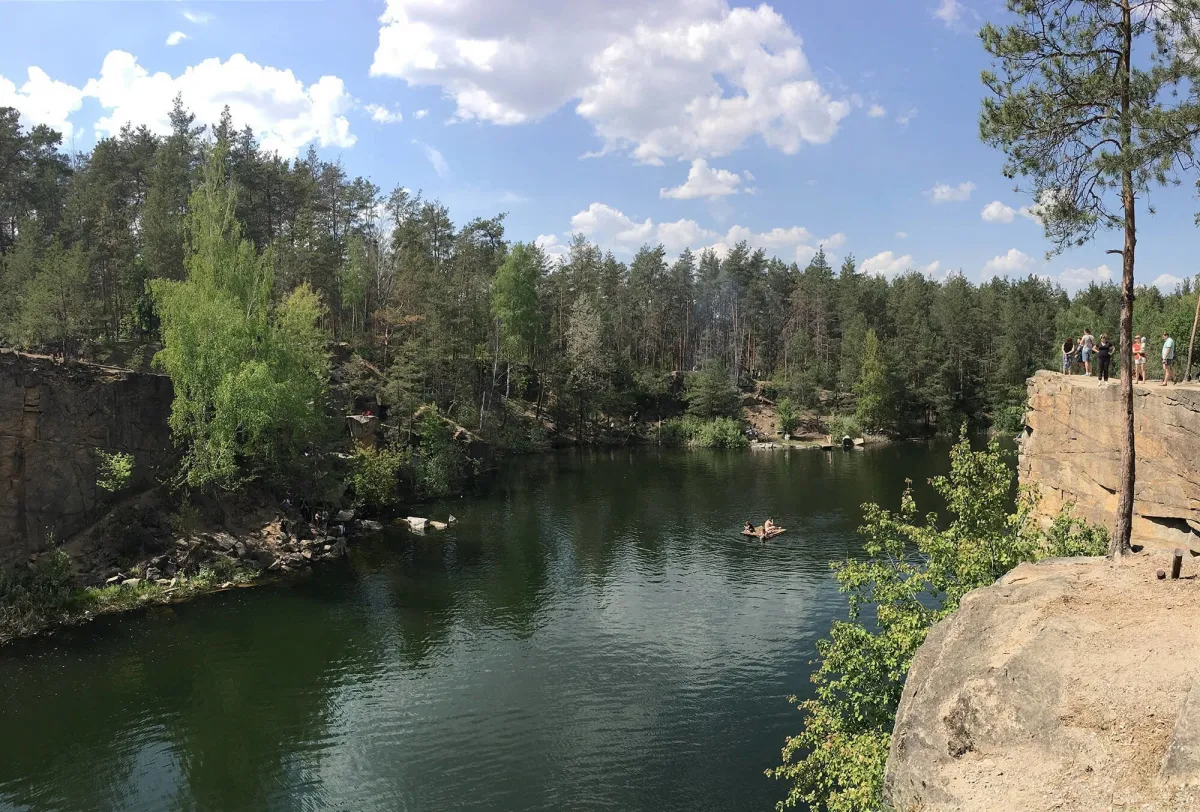
So the story of the “city of stone” does not actually begin with the flooded quarry that tourists photograph today. It begins with people who learned to see a future form in a heavy block of granite and passed this skill on. This is how a geological feature of the area gradually became a profession, an industry and part of Korostyshiv’s urban identity.