Not a Count but a Lady-in-Waiting: Who Really Owned the Neo-Gothic Estate in Levkiv Near Zhytomyr
Source: Zhytomyr Online
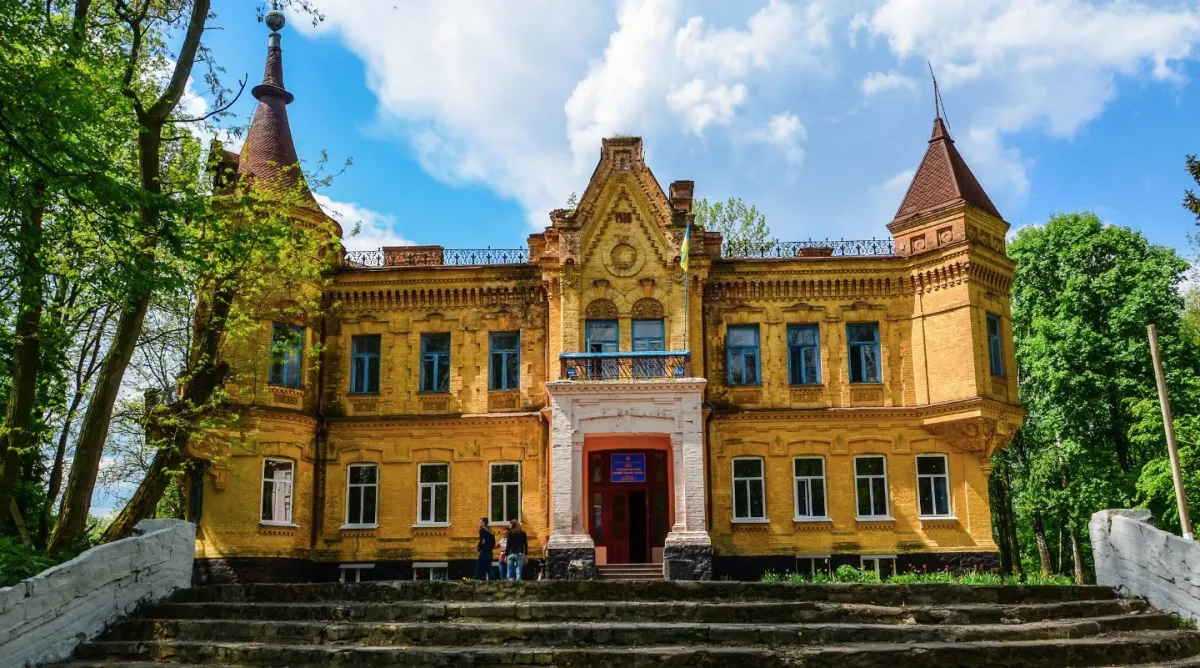
In the center of Levkiv, a few kilometers from Zhytomyr, the walls of an old manor with pointed windows and a crenellated brick facade still stand. It is called the palace of Count Nirod. But the true owner of the estate was his wife, Anastasia Nirod, née Trepova. She was born in Kyiv, was a lady-in-waiting at the imperial court, owned lands, mills and factories, and gave part of her estate for the recovery of children from poor families.
The history of this family was researched by the local history project “Ukraina Incognita.” Behind the familiar name “Nirod Palace” stands the story of a woman who had large landholdings of her own and close ties to the imperial court.
Who Anastasia Nirod Was
Anastasia Fedorivna Trepova was born in Kyiv in 1849. Her father, Fedir Trepov, was a general of cavalry and held the post of governor of the city of Saint Petersburg.
Anastasia belonged to the court circle of the Russian Empire and held the rank of lady-in-waiting. In 1870 she married Count Maximilian Yevstafiyovych Nirod, a representative of an old noble family of Swedish origin.
Maximilian himself served in the Ministry of the Interior of the Russian Empire, later became a privy councilor and a member of the State Council. His family had been linked to military and court service for several generations.
This aristocratic story has an unusual family detail: two Nirod brothers married two Trepov sisters. Maximilian’s wife was Anastasia, while his brother Mavrykii, also known as Mykhailo Nirod, married Sofia Trepova.
The Levkiv estate was the personal property of Anastasia Fedorivna. Maximilian had separate landholdings, in particular in Horodyshche in the former Zhytomyr county and in Mala Liubashka in the Rivne region.
Factories, Mills and a Sawmill Operated in Levkiv
At the end of the 19th century, Levkiv was much more than an ordinary country estate. The countess’s holdings included the lands of surrounding settlements, businesses, mills and forests.
The family itself mostly lived in Saint Petersburg and came to Levkiv mainly in summer. The business properties were leased out.
For example, in 1907 Collegiate Councilor Vasyl Rymsky-Korsakov leased 1,200 desyatinas of land from Anastasia Nirod’s holdings. He was also linked to the lease of the local distillery.
In the early 20th century, the countess’s holdings included a distillery and rectification plant, water mills and a sawmill in the Liubna tract. According to local history sources, in 1913 the distillery employed 25 people, and annual output was about 140,000 liters of spirits.
The estate lived primarily through its business activity. Next to the count’s residence, hired workers were employed, peasants tilled the land, and leaseholders managed the enterprises.
The Countess Gave Land for a Sanatorium Where Children Recovered
One of the most interesting episodes in Anastasia Nirod’s life is linked to a children’s sanatorium near the Teteriv River.
In 1897 the countess provided part of her lands in a pine forest for a summer health facility named after Grand Duchess Olga Nikolaevna.
The sanatorium was under the care of the Zhytomyr Committee of the Red Cross Society. Its creation was initiated by Yelyzaveta Trepova, a relative of the countess.
Two wooden buildings designed for 100 children, 50 boys and 50 girls, were built on the allotted land. Benefactors raised almost 14,000 rubles for the construction.
In its first year the sanatorium operated for 75 days. During that time 105 children stayed there, including pupils of schools and gymnasiums and residents of an orphanage and children’s shelters.
The facility was created first of all for children from poor families who needed to recover over the summer.
How the Revolution Changed the Family’s Fate
At the end of 1917, the situation of Levkiv’s owners changed sharply. In November and December, peasants attacked the estate several times, seized a timber warehouse, damaged farm buildings and refused to pay rent.
After these events, Anastasia Nirod agreed to lease 600 desyatinas of land to the peasants and reduce the rent.
Her husband Maximilian had died back in 1914. After the revolutionary events, the family gradually lost its former holdings.
In 1920 Anastasia’s daughter Vira died. Later the countess left for France together with the family of her son Fedir.
The estate in Levkiv remained. In Soviet times one part of the manor was rebuilt for public needs, and the other gradually fell into ruin.
A Descendant of the Nirods Returned to Levkiv a Century Later
The story of this family unexpectedly continued in the 21st century.
In May 2019, Yaroslav Nirod came to the estate. He is a theater designer, a representative of another branch of the count’s family, and a great-grandson of Mavrykii Nirod, brother of the manor’s former owner Maximilian.
The visit took place with the assistance of Zhytomyr local historian Ihor Dovbysh.
The Nirod family also left a notable mark on Ukrainian art. Members of this branch became theater designers and worked on the staging of opera and drama productions.
What Remains of the Neo-Gothic Manor
The most striking part of the old estate is a red-brick building with neo-Gothic features. Its facade is adorned with pointed window openings, decorative arches and a crenellated parapet resembling the decoration of medieval castles.
Today cracks are visible in the walls, some of the windows are missing, and the building is gradually being swallowed by vegetation.
The manor once consisted of two connected parts. One of them was converted into a village club and library in Soviet times, while the neo-Gothic part has survived in a half-ruined state.
You can see the building and its architectural details in a video tour of the Nirod manor that Zhytomyr Online published in 2024.
In August 2025, researchers from “Ukraina Incognita” again drew attention to the condition of the structure. To preserve it, they called for architectural studies, conservation and restoration.
In the center of Levkiv, not far from the school, the brick neo-Gothic part of Anastasia Nirod’s manor still stands. Next to it is the rebuilt wing of the former estate that housed the village club and library.